
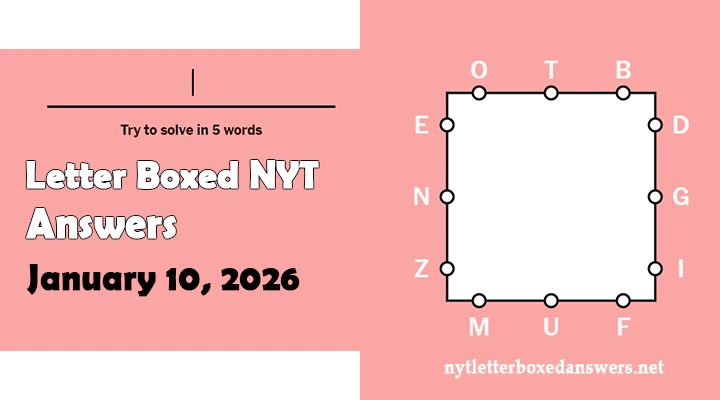
The NYT Letter Boxed quiz for Saturday, January 10, 2026, has been released. We came up with Letter Boxed January 10, 2026, Answers and Hints for you. With the help of these hints, you will be able to guess the words of the letter boxed quiz without revealing the answers and get the solution.
| Top | Right | Bottom | Left |
|---|---|---|---|
| OTB | DGI | MUF | ENZ |
| Two-Word Solution | ||
|---|---|---|
| ZOMBIFIED | DEBUTING | |
| Three-Word Solution | ||
|---|---|---|
| BED | DEMOUNTED | DEFEMINIZING |
This word has 9 letters, starts with Z, and ends with D.
It is a verb (past participle).
Means turned into a zombie-like state.
Can describe someone emotionless or dazed.
Often used figuratively.
Common in horror and pop culture.
Suggests loss of awareness or control.
Used in films, games, and fiction.
Conveys mindless behavior.
The opposite might be alert or revived.
This word has 8 letters, starts with D, and ends with G.
It is a verb (present participle).
Means appearing or being introduced for the first time.
Common in entertainment and sports.
Used for new performers or products.
Suggests a beginning or launch.
Often associated with public appearances.
Indicates something new.
Used in news headlines.
The opposite might be retiring or withdrawing.
This word has 3 letters, starts with B, and ends with D.
It is a noun.
Refers to a piece of furniture for sleeping.
Found in bedrooms.
Used for rest or sleep.
Can also mean a layer or foundation.
Appears in phrases like riverbed.
Common in everyday life.
Associated with comfort.
The opposite might be floor.
This word has 9 letters, starts with D, and ends with D.
It is a verb (past tense).
Means got off a horse or vehicle.
Often used in military or historical contexts.
Can refer to removing equipment.
Used when someone leaves a mounted position.
Common in formal writing.
Associated with travel or combat.
Indicates a change of position.
The opposite might be mounted.
This word has 12 letters, starts with D, and ends with G.
It is a verb (present participle).
Means removing feminine characteristics.
Used in social or cultural discussions.
Often appears in academic writing.
Can relate to language or behavior.
Describes a process of change.
Less common in everyday speech.
Has a strong analytical tone.
The opposite might be feminizing.
| Sun | Mon | Tue | Wed | Thu | Fri | Sat |
|---|---|---|---|---|---|---|
| 1 | 2 | 3 | 4 | 5 | 6 | 7 |
| 8 | 9 | 10 | 11 | 12 | 13 | 14 |
| 15 | 16 | 17 | 18 | 19 | 20 | 21 |
| 22 | 23 | 24 | 25 | 26 | 27 | 28 |
| 29 | 30 | 31 |

Chris Brown is a passionate word game love and problem solving expert. With over 15 years of experience in solving puzzle challenges, he provides daily NYT Letter Boxed answers, tips and strategies to help other players so that they can improve their solving skills. Whether you are stuck on a tricky puzzle or looking for new techniques, Chris is here to guide you with his expert solutions.