
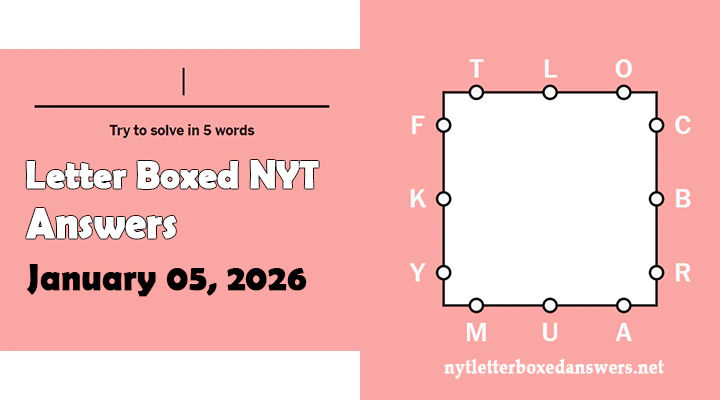
The NYT Letter Boxed quiz for Monday, January 5, 2026, has been released. We came up with Letter Boxed January 5, 2026, Answers and Hints for you. With the help of these hints, you will be able to guess the words of the letter boxed quiz without revealing the answers and get the solution.
| Top | Right | Bottom | Left |
|---|---|---|---|
| TLO | CBR | MUA | FKY |
| Two-Word Solution | ||
|---|---|---|
| COMFORTABLY | YUK | |
| Three-Word Solution | ||
|---|---|---|
| ARMFUL | LAYABOUT | TUCK |
This word has 11 letters, starts with C, and ends with Y.
It is an adverb.
Describes doing something with ease or without discomfort.
Often used to describe physical or emotional ease.
Can refer to having enough money or resources.
Common in everyday and descriptive language.
Suggests relaxation and satisfaction.
Used in phrases like “live comfortably.”
Implies absence of strain.
The opposite might be uncomfortably or awkwardly.
This word has 3 letters, starts with Y, and ends with K.
It is an exclamation.
Used to express disgust or dislike.
Common in informal speech.
Often said in reaction to unpleasant food or sights.
Similar in meaning to “yuck.”
Conveys strong negative reaction.
Used mostly in spoken language.
Short and expressive.
The opposite might be yum or delight.
This word has 6 letters, starts with A, and ends with L.
It is a noun.
Refers to as much as can be held in one’s arms.
Often used for carrying objects.
Common in everyday descriptions.
Can describe a large quantity.
Used for items like books, firewood, or clothes.
Suggests fullness or abundance.
Appears in informal language.
The opposite might be a handful or small amount.
This word has 8 letters, starts with L, and ends with T.
It is a noun.
Refers to a lazy or idle person.
Describes someone who avoids work.
Often used in a critical or humorous way.
Common in British English.
Suggests lack of ambition or effort.
Used in informal speech.
Carries a mildly negative tone.
The opposite might be a hard worker or go-getter.
This word has 4 letters, starts with T, and ends with K.
It can be a verb or a noun.
As a verb, it means to fold or push something neatly into place.
Often used with bedsheets or clothing.
As a noun, it can refer to a pleat or fold.
Also used in phrases like “tuck in.”
Common in daily activities.
Suggests neatness and order.
Can also mean to eat enthusiastically (informal).
The opposite might be untuck or loosen.
| Sun | Mon | Tue | Wed | Thu | Fri | Sat |
|---|---|---|---|---|---|---|
| 1 | 2 | 3 | 4 | 5 | 6 | 7 |
| 8 | 9 | 10 | 11 | 12 | 13 | 14 |
| 15 | 16 | 17 | 18 | 19 | 20 | 21 |
| 22 | 23 | 24 | 25 | 26 | 27 | 28 |
| 29 | 30 | 31 |

Chris Brown is a passionate word game love and problem solving expert. With over 15 years of experience in solving puzzle challenges, he provides daily NYT Letter Boxed answers, tips and strategies to help other players so that they can improve their solving skills. Whether you are stuck on a tricky puzzle or looking for new techniques, Chris is here to guide you with his expert solutions.